Cooking, reheating and hot holding log: free template
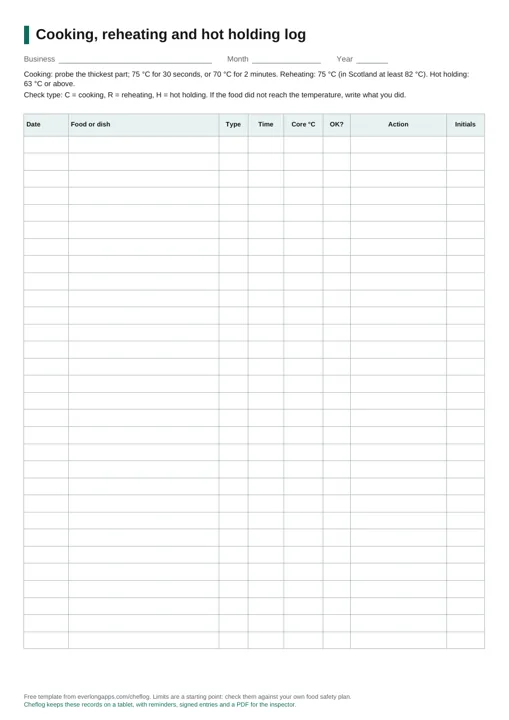
Cooking, reheating and hot holding log
Free PDF, A4 portrait, 41 KB. Print as many as you need.
Download the PDFCore temperatures for cooking
Food is safe when its centre has been hot enough for long enough. These combinations kill harmful bacteria equally well:
| Core temperature | Hold it for |
|---|---|
| 80 °C | 6 seconds |
| 75 °C | 30 seconds |
| 70 °C | 2 minutes |
| 65 °C | 10 minutes |
| 60 °C | 45 minutes |
Time and temperature combinations from the Food Standards Agency's cooking guidance, as used in Cheflog's UK pack.
Poultry, pork, rolled joints, burgers, sausages, liver and offal must be cooked all the way through. Whole cuts of beef and lamb, such as steaks and whole joints, can be served rare as long as all the outside surfaces are fully cooked, because bacteria sit on the surface. Burgers served pink need extra controls that you agree with your local authority.
Reheating
- Reheat until the food is steaming hot all the way through; Cheflog's UK pack checks for 75 °C at the core.
- In Scotland the law sets at least 82 °C for food reheated for service, unless that would spoil it.
- Reheat only once, and never in a bain-marie or hot cabinet: they keep food hot, they don't heat it up.
Hot holding and the 2-hour rule
Hot food on display or kept for service must be held at 63 °C or above. The law allows one exception: food that has been kept for service or display for less than two hours, and only once. After that, reheat it until steaming hot, chill it quickly or throw it away. Check hot cabinets and bains-marie regularly through service; Cheflog's default is every two hours.
How to probe
- Clean the probe. Use a probe wipe or clean and disinfect it before and after each food, so it doesn't spread bacteria.
- Go to the thickest part. Push the tip into the centre of the thickest piece, away from bone and the pan.
- Wait for the reading to settle. Leave it until the number stops rising, then read it.
- Write it down. Date, food, time, core temperature and your initials. If it is too low, cook or reheat it longer and probe again.
How often to probe
Safer food, better business doesn't ask you to probe every portion. It asks you to know your safe methods work. Many kitchens probe each new dish or batch and every batch of high-risk food such as poultry, minced meat and rolled joints. They probe again whenever a recipe, a portion size or a piece of equipment changes. Your own food safety plan sets the routine; the log shows that it happened.
Questions
What core temperature should food be cooked to in the UK?
75 °C for 30 seconds or 70 °C for 2 minutes are the usual targets. Other combinations such as 65 °C for 10 minutes work too, as long as the food is held at that temperature for the time given.
What temperature should hot food be held at?
At 63 °C or above. By law, hot food can be below 63 °C for less than two hours, once, for service or display.
How many times can food be reheated?
Once. Reheat until it is steaming hot all the way through; in Scotland, to at least 82 °C.
Do I have to record every cooking temperature?
Not by law. You need to show that your methods work, and records of regular probe checks are the simplest proof.

Or let Cheflog keep this record for you
Cheflog is a food safety app for the kitchen tablet. It reminds you what is due, takes the reading with big keys, asks for the corrective action when a value is out of range and keeps signed records an inspector can read. Try it free for 30 days, then pay once (€49.99), no subscription.
See how Cheflog worksSources
- SFBB safe method: cooking safely (PDF)
- Food hygiene for your business: cooking (gov.uk)
- SFBB safe method: reheating (PDF)
- SFBB safe method: hot holding (PDF)
- The Food Safety and Hygiene (England) Regulations 2013, Schedule 4: temperature control
- The Food Hygiene (Scotland) Regulations 2006, Schedule 4
Sources checked on 6 November 2026.
This page is general information, not legal advice. Limits in the templates are a starting point: check them against your own food safety plan and ask your local authority if you are unsure. Cheflog and Everlong are not connected to the Food Standards Agency, Food Standards Scotland or any other authority, and nothing here is approved by them.