Fridge and freezer temperature log: free printable template
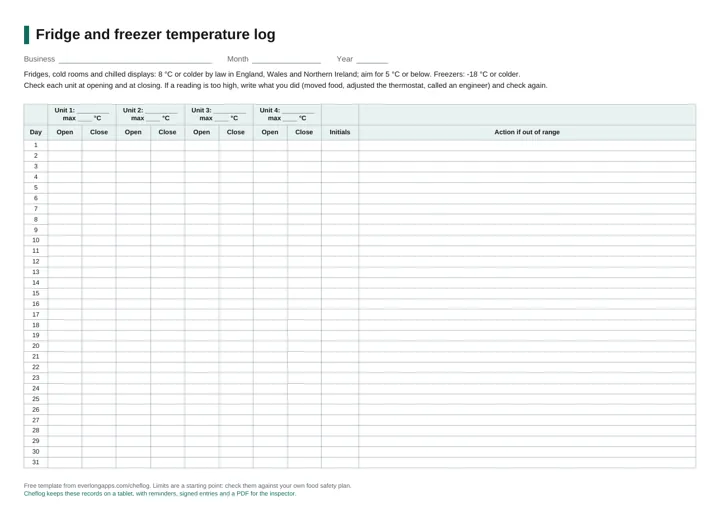
Fridge and freezer temperature log
Free PDF, A4 landscape, 42 KB. Print as many as you need.
Download the PDFHow to use the log
- Write the name of each unit at the top (for example Fridge 1, under the pass) and its limit: 8 °C for fridges and displays, -18 °C for freezers.
- At opening, read each unit and write the temperature in the Open column. Do the same at closing if you check twice a day.
- Initial each line. If a reading is above the limit, write what you did in the last column and check again later.
- At the end of the month, sign the sheet off and keep it with your other records.
Fridge and freezer temperatures in the UK
| Unit | Keep food at | Where it comes from |
|---|---|---|
| Fridges, cold rooms, chilled displays | 8 °C or below; set the unit at 5 °C or below | Legal limit in England, Wales and Northern Ireland (Schedule 4); 5 °C is the FSA's recommendation in Safer food, better business |
| Freezers | -18 °C or below | Safer food, better business, Prove it |
| Scotland | 8 °C or below recommended, 5 °C or below as the target | CookSafe and the Food Hygiene (Scotland) Regulations 2006 |
The 5 °C setting leaves a margin: a fridge that is opened all through service warms up, and the food inside should still stay at 8 °C or below. For the other countries Cheflog covers, see the limits by country.
How often to check, and with what
Safer food, better business says to check fridges and chilled displays at least once a day. Most kitchens do it as part of the opening checks, and a second check at closing catches a fridge that fails during the day.
Reading the fridge's own display is fine for the daily check, as long as you check now and then that the display is right. The FSA's method is to probe in between two packs of chilled food with a clean, disinfected probe thermometer and compare it with the display. Make sure the probe itself is accurate: see how to check a probe thermometer.
If a reading is too high
- Check again with a probe between packs of food, not in the air near the door.
- If food is above 8 °C, move it to another fridge or a cold area straight away.
- Work out how long it has been warm. The FSA's rule: food that needs refrigeration and has not been kept chilled for more than four hours should be thrown away.
- Find the cause: door left open, overloaded shelves, blocked vents, a worn door seal, the thermostat or a fault that needs an engineer.
- Write down what happened and what you did. That line is what an inspector looks for.
There is a full walkthrough in fridge temperature too high: what to do.
Paper or app?
A paper log works if someone fills it in every day and the sheets are kept. The weak spots are the ones inspectors notice: blank days, the same number written every day and corrections that cover the original. An app like Cheflog reminds whoever is on shift, keeps each reading signed with initials and lists any check that was missed on the printout.
Questions
What temperature should a commercial fridge be in the UK?
Chilled food must be kept at 8 °C or below by law in England, Wales and Northern Ireland. The Food Standards Agency recommends setting fridges and chilled displays at 5 °C or below so the food stays under 8 °C.
How often should I record fridge temperatures?
At least once a day, which is what Safer food, better business asks for. Many kitchens check at opening and at closing.
Do I have to keep fridge temperature records?
The law asks food businesses to have food safety procedures based on HACCP principles and records that fit the size of the business. Safer food, better business, the FSA's pack for small caterers, includes daily checks in its diary, and inspectors look at these records when they score confidence in management.
How long should I keep the logs?
The FSA says to store completed diary pages safely until the next visit from your local authority's food safety officer. Many businesses keep them for at least a year.
What temperature should a freezer be?
Frozen food should be kept at -18 °C or below.
Or let Cheflog keep this record for you
Cheflog is a food safety app for the kitchen tablet. It reminds you what is due, takes the reading with big keys, asks for the corrective action when a value is out of range and keeps signed records an inspector can read. Try it free for 30 days, then pay once (€49.99), no subscription.
See how Cheflog worksSources
- SFBB safe method: chilled food storage and display (PDF)
- SFBB management: Prove it (PDF)
- The Food Safety and Hygiene (England) Regulations 2013, Schedule 4: temperature control
- Safer food, better business: how to use the pack and diary (gov.uk)
- CookSafe (Food Standards Scotland)
Sources checked on 6 November 2026.
This page is general information, not legal advice. Limits in the templates are a starting point: check them against your own food safety plan and ask your local authority if you are unsure. Cheflog and Everlong are not connected to the Food Standards Agency, Food Standards Scotland or any other authority, and nothing here is approved by them.