Cooling log: how to cool cooked food safely
Why cooling needs a record
Some bacteria, such as Clostridium perfringens in stews and gravies and Bacillus cereus in rice, survive cooking as spores. They wake up and multiply while food sits warm. Cooling quickly through that range is what keeps them in check, and a cooling log shows that you do it every time.
How to cool faster
- Divide food into smaller portions or spread it out in shallow trays, for example rice.
- Cover pans and move them to a colder area, or stand them in cold water or an ice bath and stir.
- Use a blast chiller if you have one: it is built for this.
- Don't put a large pot of hot food straight into a full fridge; it warms everything else up.
- Once the food is cool, label it with the date and put it in the fridge.
Cooling rules compared
| Country | Rule | Status |
|---|---|---|
| England, Wales, Northern Ireland | As quickly as possible, then into the fridge (8 °C or below) | Law and FSA guidance; no exact time |
| Scotland | As quickly as possible; record when it went into the fridge | CookSafe |
| Germany | From 60 °C to 7 °C or below within 2 hours | BfR advice; law for cold dishes with raw egg |
| France | From +63 °C to below +10 °C within 2 hours, then +3 °C or below | Law (arrêté of 21 December 2009) |
Cheflog uses 8 °C within 2 hours as its UK default because no official figure exists; you can change it.
What to write down
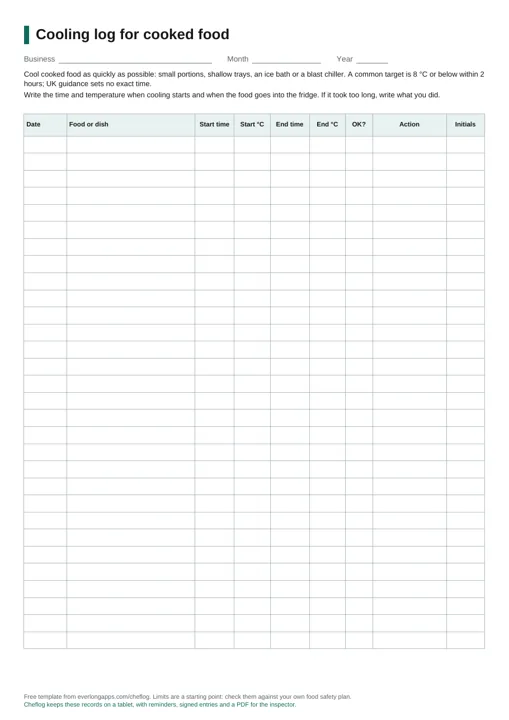
For each batch: the date, the food, when cooling started and the temperature then, when it ended (usually when the food went into the fridge) and the temperature then, plus your initials. If it took too long, the FSA's advice is to re-cook the food if that is appropriate, or throw it away, and then review how you cool.
Questions
How long should it take to cool cooked food?
As short as possible. UK law and the FSA set no exact time; 8 °C or below within 2 hours is a common target, and in France the legal rule is below 10 °C within 2 hours.
Can I put hot food straight into the fridge?
Small portions, yes, once the steam has gone. A large pot warms up everything around it, so divide it or cool it in cold water first.
What should I do if food cooled too slowly?
Re-cook it if that is appropriate, or throw it away. Then look at your method: smaller portions, shallower trays or a cold water bath.

Or let Cheflog keep this record for you
Cheflog is a food safety app for the kitchen tablet. It reminds you what is due, takes the reading with big keys, asks for the corrective action when a value is out of range and keeps signed records an inspector can read. Try it free for 30 days, then pay once (€49.99), no subscription.
See how Cheflog worksSources
- SFBB safe method: chilling down hot food (PDF)
- Regulation (EC) No 852/2004, Annex II, as it applies in Great Britain
- CookSafe (Food Standards Scotland)
- Arrêté du 21 décembre 2009, annex IV (Légifrance)
- BfR: Sicher verpflegt (German Federal Institute for Risk Assessment, PDF)
Sources checked on 6 November 2026.
This page is general information, not legal advice. Limits in the templates are a starting point: check them against your own food safety plan and ask your local authority if you are unsure. Cheflog and Everlong are not connected to the Food Standards Agency, Food Standards Scotland or any other authority, and nothing here is approved by them.