Kitchen cleaning schedule: free template for restaurants
What goes on a cleaning schedule
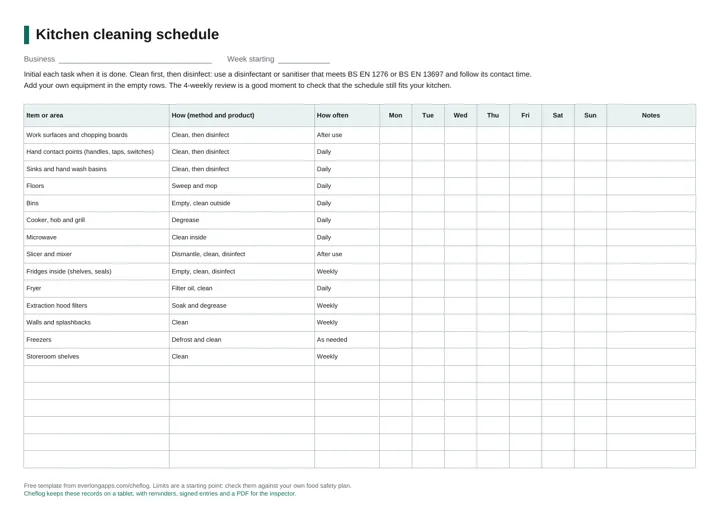
- What: every surface, piece of equipment and area, including the ones nobody looks at, like hood filters and the tops of fridges.
- How: the method and the product, with its dilution and contact time.
- How often: after use, daily, weekly or monthly.
- Who and when: initials each time it is done, so you can see at a glance what was missed.
Two-stage cleaning
- Clean. Remove food, grease and dirt with hot water and detergent. Disinfectant doesn't work through dirt.
- Disinfect. Apply a disinfectant or sanitiser that meets BS EN 1276 or BS EN 13697 and leave it for the contact time on the label.
- Rinse and dry if the label says so, with a clean single-use cloth or one that is washed hot after use.
How often to clean what
| Item | How often |
|---|---|
| Work surfaces, chopping boards, utensils | After each use, and between raw and ready-to-eat food |
| Hand contact points: handles, taps, switches, probe | Daily, and more often during service |
| Floors, sinks, bins | Daily |
| Fridges inside, walls, storeroom shelves | Weekly |
| Extraction hood filters | Weekly to monthly, depending on use |
| Freezers | When ice builds up, or at least a few times a year |
Typical frequencies; your own kitchen and the manufacturer's instructions decide.
Clear and clean as you go
The schedule covers planned cleaning. Clear and clean as you go covers the rest: wipe spills straight away, clear used equipment and keep raw and ready-to-eat areas apart. Inspectors notice both.
Questions
Is a cleaning schedule a legal requirement?
The law requires premises and equipment to be kept clean. A cleaning schedule is how Safer food, better business and most food safety plans show that you do it, and inspectors expect to see one.
What is the difference between a detergent and a disinfectant?
A detergent removes grease and dirt; a disinfectant kills bacteria on a clean surface. Sanitisers do both, but still need a clean surface and the full contact time.
Which disinfectant should I use?
One that meets BS EN 1276 or BS EN 13697, used at the dilution and contact time on its label.
Or let Cheflog keep this record for you
Cheflog is a food safety app for the kitchen tablet. It reminds you what is due, takes the reading with big keys, asks for the corrective action when a value is out of range and keeps signed records an inspector can read. Try it free for 30 days, then pay once (€49.99), no subscription.
See how Cheflog worksSources
- SFBB safe method: your cleaning schedule (PDF)
- Safer food, better business for caterers (Food Standards Agency)
Sources checked on 6 November 2026.
This page is general information, not legal advice. Limits in the templates are a starting point: check them against your own food safety plan and ask your local authority if you are unsure. Cheflog and Everlong are not connected to the Food Standards Agency, Food Standards Scotland or any other authority, and nothing here is approved by them.