The 14 allergens: list and allergen matrix template
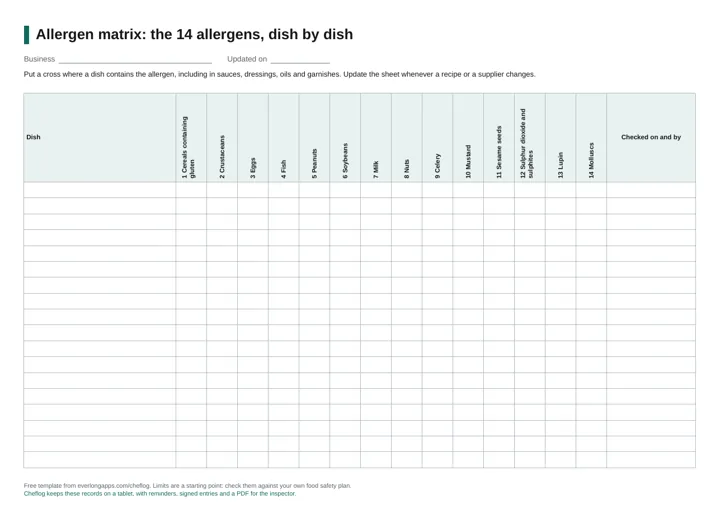
Allergen matrix: the 14 allergens, dish by dish
Free PDF, A4 landscape, 41 KB. Print as many as you need.
Download the PDFThe 14 allergens
| No. | Allergen | Includes |
|---|---|---|
| 1 | Cereals containing gluten | Wheat (such as spelt and khorasan wheat), rye, barley, oats |
| 2 | Crustaceans | Crabs, lobster, prawns, scampi |
| 3 | Eggs | |
| 4 | Fish | |
| 5 | Peanuts | |
| 6 | Soybeans | |
| 7 | Milk | Including lactose |
| 8 | Nuts | Almonds, hazelnuts, walnuts, cashews, pecans, Brazil nuts, pistachios, macadamia nuts |
| 9 | Celery | Including celeriac |
| 10 | Mustard | |
| 11 | Sesame seeds | |
| 12 | Sulphur dioxide and sulphites | Above 10 mg per kg or per litre |
| 13 | Lupin | |
| 14 | Molluscs | Mussels, oysters, squid, snails |
From Annex II of Regulation (EU) No 1169/2011, which also applies in the UK.
How to fill in the matrix
- List every dish and component. Include sauces, dressings, bread, garnishes and the oil you fry in.
- Check each ingredient's label. Use the supplier's specification or the label of each product, not memory.
- Mark the allergens. Put a cross in each allergen a dish contains. Leave nothing to guess.
- Date and sign it. Update the sheet whenever a recipe, a product or a supplier changes.
Food that isn't prepacked
For food served in a restaurant or sold loose, you must give allergen information for every item that contains any of the 14 allergens. The FSA lists two ways: full written information on a menu, chalkboard or in an information pack, or verbally, with a written notice in a clearly visible place telling customers to ask. Written information backed by a conversation works best. If staff give the answer, it has to be right every time, which is what the matrix is for.
Prepacked for direct sale
Food packed on the premises before a customer orders it, such as sandwiches in a chiller, is prepacked for direct sale (PPDS). Since 1 October 2021 it needs a label with the name of the food and a full ingredients list with the allergens emphasised, for example in bold.
Keep allergens apart in the kitchen
Separate storage, clean equipment and fresh oil for allergen-free orders matter as much as the paperwork. If you can't avoid cross-contact, say so honestly rather than promising a dish is free from an allergen.
Questions
Is an allergen matrix a legal requirement?
No particular form is required. You must give accurate allergen information for every dish; a matrix is the usual way to have it written down and up to date.
Can allergen information be given verbally?
For food that isn't prepacked, yes, if a written notice in a clearly visible place tells customers to ask staff. The answers must be accurate and consistent.
What is Natasha's Law?
The rule, in force since 1 October 2021, that food prepacked for direct sale must carry a label with a full ingredients list and the allergens emphasised.
Are the 14 allergens the same in the UK and the EU?
Yes. The list comes from Annex II of Regulation (EU) No 1169/2011, which still applies in the UK.

Or let Cheflog keep this record for you
Cheflog is a food safety app for the kitchen tablet. It reminds you what is due, takes the reading with big keys, asks for the corrective action when a value is out of range and keeps signed records an inspector can read. Try it free for 30 days, then pay once (€49.99), no subscription.
See how Cheflog worksSources
- Allergen guidance for food businesses (Food Standards Agency)
- Regulation (EU) No 1169/2011, Annex II: the 14 allergens
- SFBB management: managing food allergen information (PDF)
Sources checked on 6 November 2026.
This page is general information, not legal advice. Limits in the templates are a starting point: check them against your own food safety plan and ask your local authority if you are unsure. Cheflog and Everlong are not connected to the Food Standards Agency, Food Standards Scotland or any other authority, and nothing here is approved by them.